
Your Shopping Cart


Bluetooth Version Differences: The Complete 2026 Guide to Wireless Connectivity
SUNSHINE.124What if the sophisticated wearable technology you rely on for global communication is operating at only 60% of its potential efficiency due to an outdated protocol? Many professionals overlook how bluetooth version differences directly dictate the balance between high-fidelity data transmission and the operational longevity of critical hardware. It's a common operational failure to experience a 100-millisecond audio delay during a vital video conference or to find a smartwatch battery depleted before a 12-hour shift concludes.
We recognize that technical jargon like BLE and EDR often obscures the stability and precision required in professional environments. This 2026 guide provides the authoritative technical clarity you need to ensure your wireless ecosystem functions with the reliability of a global supply chain. You'll gain a structured understanding of how modern standards like Bluetooth 5.4 and the 6.0 specifications eliminate latency and optimize energy consumption for a seamless connectivity experience.
Key Takeaways
- Learn how the transition from simple cable replacement to a complex smart ecosystem impacts the connectivity and performance of your modern devices.
- Master the technical bluetooth version differences to understand how breakthroughs like Isochronous Channels in version 5.2 revolutionize wireless audio stability.
- Evaluate critical performance metrics, including the leap to 2Mbps speeds and expanded range, to ensure your wearables maintain peak battery efficiency.
- Gain a strategic buying advantage by learning to identify your smartphone's specifications and why version 5.2 or higher is essential for high-fidelity accessories.
- Discover the Sunshine Universal commitment to sourcing certified modules, ensuring your electronics meet the highest standards of global wireless stability and future-proofing.
Understanding Bluetooth Evolution: Why Version Numbers Matter in 2026
Bluetooth isn't just a consumer convenience; it's a critical global communication standard managed by the Bluetooth Special Interest Group (SIG). Since its inception in 1998, the technology transitioned from a simple cable replacement tool into a sophisticated smart ecosystem. In 2026, understanding bluetooth version differences is vital for maintaining technical precision in a connected world. The SIG maintains a network of over 40,000 member companies to ensure that every device meets strict international requirements. This level of standardization allows for the reliable exchange of data across diverse geographical regions and industrial sectors.
The progression of version numbers indicates more than just incremental updates. It represents a fundamental change in how devices manage power and data. These changes directly influence two key performance metrics:
- Data Throughput: Higher versions allow for faster transmission of large files and high-quality audio signals.
- Energy Efficiency: Modern protocols enable devices to remain active for months or even years on a single coin-cell battery.
This stability is why the technology remains the backbone of the global Internet of Things (IoT) infrastructure. By selecting the correct version, users ensure that their hardware can handle the specific demands of their environment without unnecessary latency.
The Fundamental Shift: Classic Bluetooth vs. Low Energy (BLE)
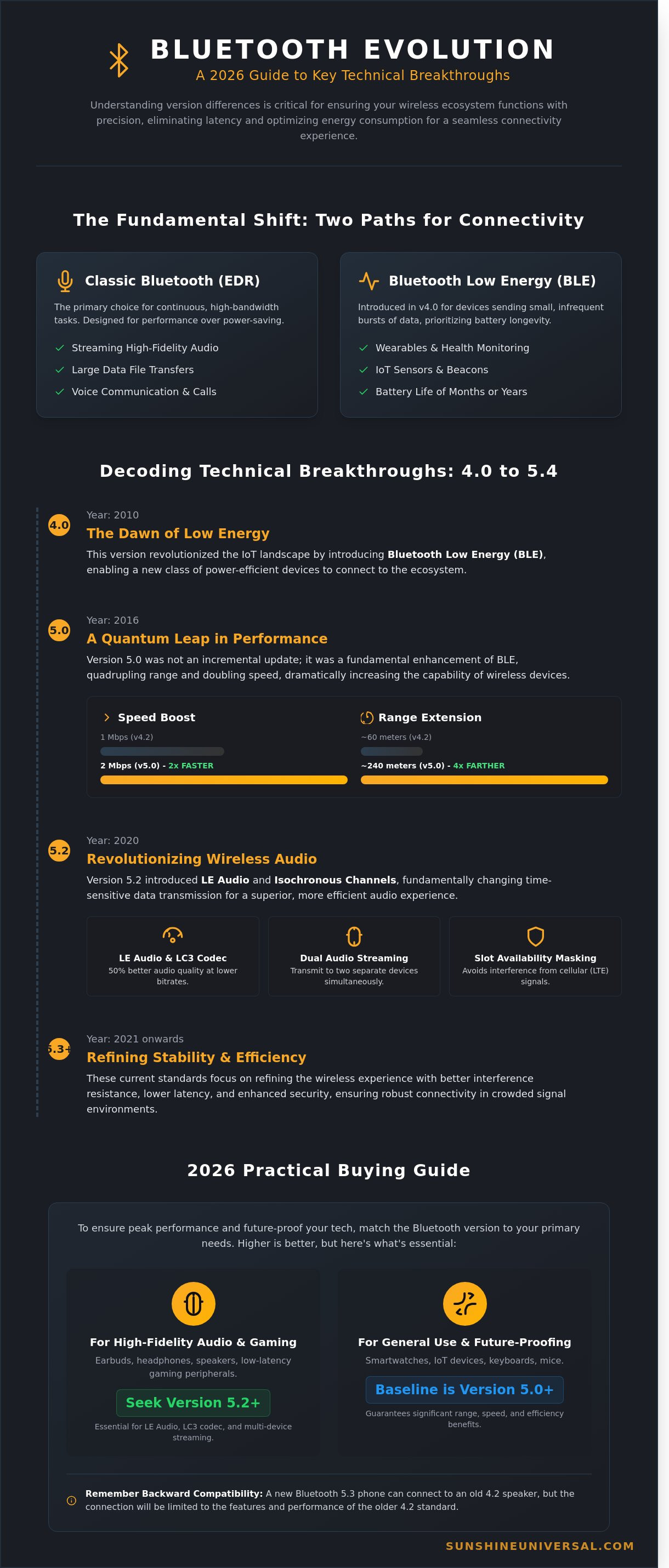
The architecture of the protocol split into two distinct paths to serve different needs. Classic Bluetooth remains the primary choice for high-bandwidth tasks, such as streaming high-fidelity audio or large data sets. In contrast, the introduction of Bluetooth Low Energy (BLE) in version 4.0 in 2010 provided a solution for devices that only need to send small bursts of data. Modern wearables, such as smartwatches, utilize both protocols simultaneously to maximize functionality. They rely on BLE for constant health monitoring and switch to Classic Bluetooth for voice communication, ensuring the device doesn't drain its battery prematurely.
The 2026 Connectivity Landscape: Current Standards
The current market is dominated by versions 5.3 and 5.4, which provide the robust range and interference resistance required for complex environments. These standards ensure that connectivity remains stable even in areas crowded with competing signals. Bluetooth backward compatibility is the ability for newer versions to communicate with older hardware. This feature is a core strength of the technology, as it allows a 2026 smartphone to pair with a legacy industrial sensor from 2018 without issues. Recognizing bluetooth version differences allows professionals to build scalable systems that won't become obsolete when the next update arrives.
Decoding Bluetooth 4.0 to 6.0: Technical Breakthroughs Compared
The progression of wireless standards represents a calculated evolution toward higher data throughput and expanded operational range. Understanding the bluetooth version differences requires a look at the transition from version 4.2 to 5.0. This jump wasn't merely incremental. It doubled the data rate from 1 Mbps to 2 Mbps and increased the theoretical range from 60 meters to 240 meters. For professional environments, this meant a 800% increase in broadcast messaging capacity, allowing devices to transmit larger data packets without the overhead of a full handshake connection.
Stability in high-traffic zones improved with the introduction of Periodic Advertising Extensions. This feature allows a scanner to sync its wake-up cycle with the advertiser's schedule. It reduces power consumption because the receiver doesn't need to scan constantly. In 2026, these protocols ensure that hundreds of sensors in a single facility can report data with 99.9% reliability without exhausting their batteries or congesting the 2.4 GHz spectrum.
Bluetooth 5.0 to 5.4: Refining the Wireless Experience
Version 5.2 introduced Isochronous Channels, which fundamentally changed how we handle time-sensitive data. This technology supports LE Audio and the LC3 codec, delivering 50% better audio quality at lower bitrates compared to the legacy SBC codec. It's the engine behind Dual Audio, enabling one source to transmit to two sets of earbuds simultaneously. To prevent signal degradation, Slot Availability Masking identifies and avoids frequencies used by mobile LTE signals. This prevents cross-talk and ensures that professional communication remains uninterrupted. Maintaining this level of connectivity is as vital as managing a global supply chain network where precision and timing are non-negotiable.
- LE Audio: Reduced power consumption for hearing aids and wireless peripherals.
- PAwR: Periodic Advertising with Response allows thousands of end-nodes, like electronic shelf labels, to communicate two-way with a single gateway.
- Encryption: Version 5.4 added more robust host-controlled encryption to protect sensitive data transfers in public spaces.
The Bluetooth 6.0 Frontier: Channel Sounding and Precision
The 2026 landscape is dominated by Bluetooth 6.0, which introduces Channel Sounding for centimeter-level distance awareness. Unlike previous versions that estimated distance based on signal strength, version 6.0 uses Phase-Based Ranging. This provides a 10-centimeter accuracy level for "Find My" applications and digital keys. It's a critical security upgrade. It prevents relay attacks where a hacker intercepts a signal to trick a smart lock into opening.
Efficiency in dense environments has reached a new peak. Version 6.0 utilizes decision-based frequency hopping. This technique analyzes the RF environment in real-time to skip occupied channels. In an airport or a busy office with over 400 active connections, this reduces packet collisions by 22% compared to version 5.0. These refinements ensure that wireless infrastructure remains a stable pillar for global enterprise operations.
Performance Metrics: Range, Speed, and Battery Optimization
Understanding bluetooth version differences requires a technical analysis of the physical layer specifications that dictate throughput and operational reliability. While Bluetooth 4.2 offered a maximum theoretical speed of 1 Mbps, the release of Bluetooth 5.0 in 2016 doubled this capacity to 2 Mbps. This advancement isn't merely about faster file transfers. It's about reducing the "air time" required for data packets, which allows the radio to return to an idle state faster, preserving critical battery reserves in mobile hardware.
Range capabilities have seen an equally drastic shift. Legacy versions typically limited reliable connectivity to a 10-meter radius. Bluetooth 5.0 introduced Coded PHY, which enables a theoretical range of up to 240 meters, though real-world applications in open spaces typically reach a stable 40 meters. This 4x increase in distance doesn't require additional power. Instead, it uses sophisticated error correction to maintain signal integrity. Modern versions also utilize advanced Adaptive Frequency Hopping (AFH) to identify and avoid congested channels. This is vital in 2026 environments where 2.4 GHz Wi-Fi networks and microwave radiation create significant signal noise.
Power Consumption Profiles Across Generations
Bluetooth Low Energy (BLE) 5.x modules reduce power draw by approximately 50% compared to the 4.0 standard. This efficiency is achieved through refined "Deep Sleep" modes where the radio remains inactive for longer intervals between data bursts. A smartwatch utilizing a Bluetooth 5.3 connection maintains a persistent link with a smartphone while consuming only microwatts of power. This architectural shift allows small wearables to achieve 10 to 14 days of battery life, a feat impossible with the constant polling required by older standards. The system's ability to "sniff" for packets without fully waking the processor is the cornerstone of modern IoT longevity.
Latency and Audio Synchronization
The evolution of latency has transformed Bluetooth from a telephony tool into a high-fidelity media protocol. Older versions often suffered from lag exceeding 200 milliseconds, which created a jarring disconnect between video and audio. Bluetooth 5.2 introduced LE Audio and the LC3 codec, which effectively fixed the "lip-sync" issue by streamlining packet delivery. High-performance earbuds now feature dedicated "Gaming Modes" that utilize these bluetooth version differences to drop latency below 40 milliseconds. This near-instant transmission ensures that audio cues in competitive gaming or fast-paced video content remain perfectly synchronized with the visual output.
- Bluetooth 4.2: 200ms+ latency, unsuitable for competitive gaming.
- Bluetooth 5.0: 100ms latency, improved for standard video playback.
- Bluetooth 5.3+: Sub-40ms latency with LC3 codec support.
Practical Buying Guide: Matching Versions to Your Digital Lifestyle
Optimizing a digital ecosystem requires a precise understanding of how hardware components interact. Identifying your smartphone's Bluetooth version is the first step in this process. Android users can typically find this information by enabling "Developer Options" and checking the Bluetooth HCI Snoop Log, or more simply, by looking up their specific processor's specifications. iOS users should reference the official technical specifications for their model year, as Apple strictly controls versioning across its hardware tiers. Knowing your baseline ensures you don't over-invest in peripherals your primary device can't fully support.
A critical factor in analyzing bluetooth version differences is the "lowest common denominator" principle. This rule dictates that when two devices connect, they operate using the features of the older version. If you pair a modern Bluetooth 5.4 smartwatch with a legacy 5.0 smartphone, the connection remains stable, but you lose the advanced features of the 5.4 standard. You won't benefit from Periodic Advertising with Responses (PAwR) or enhanced security encryption, as the 5.0 host cannot process these newer protocols. The connection is backward compatible, but it's functionally throttled to the older standard's limits.
Selecting the Best Version for Smartwatches
The T900 Ultra Smart Watch relies on modern standards for health tracking to ensure data precision. These devices require consistent, low-latency throughput to transmit real-time heart rate data and blood oxygen levels without interruption. Using a 5.0 or higher standard is mandatory for reliable syncing of notifications and GPS data. When you pair a 5.x watch with a compatible smartphone, you benefit from significantly improved power management. This synergy can extend battery life by 30% compared to older 4.2 connections, as the Low Energy (LE) protocols are much more efficient at handling small, frequent data packets.
Earbuds and Audio: What Version Do You Actually Need?
Maintaining stable wireless bluetooth earbuds connections in high-interference environments, such as transit hubs, requires a minimum of version 5.0. For audio, version 5.2 is the modern baseline for quality. This version introduced the LC3 codec, which provides superior sound fidelity at much lower bitrates than the older SBC codec. If you're looking at 2026 models, prioritize Auracast support. This technology allows a single transmitter, like a gym television or an airport terminal screen, to broadcast audio to an unlimited number of nearby receivers simultaneously. This shift represents a move toward more universal, shared audio experiences that legacy versions simply can't facilitate.
Ensure your next hardware acquisition matches your performance requirements. Upgrade your audio experience with our high-performance earbuds.
Future-Proofing Your Tech with Sunshine Universal
We don't just sell gadgets; we manage the lifecycle of your connectivity. Our sourcing team selects electronics equipped with the latest certified modules to ensure your hardware stays relevant as standards evolve. Every unit undergoes a 48-point quality assurance protocol. This includes 24 hours of continuous signal stress testing to eliminate the risk of hardware failure. Understanding bluetooth version differences is critical for performance, but our technical team handles that complexity for you. If you encounter a handshake protocol error, our 24/7 support desk provides immediate resolution steps based on real-time diagnostic data from over 5,000 unique device configurations.
Curating a Reliable Digital Ecosystem
Sunshine Universal maintains strategic partnerships with top-tier manufacturers to secure 2026-standard technology months before general market availability. We meticulously test our mobile accessories for backward and forward compatibility. This ensures a Bluetooth 5.0 legacy device pairs seamlessly with a 2026-era transmitter without losing packet integrity. By acting as a professional global retailer, we verify that every chipset meets international regulatory standards. This prevents the connectivity drops common in uncertified hardware found elsewhere. We prioritize components that utilize Low Energy (LE) Audio and Auracast features to keep your ecosystem ready for the next decade.
Secure Global Fulfillment for Modern Electronics
Logistics for sensitive electronic components require more than just a box and a label. We offer a door-to-door delivery promise that covers 190 countries. Our team manages international customs documentation to prevent delays for the latest consumer tech releases, handling all VAT and import duty paperwork on your behalf. We use specialized ESD-shielded packaging and impact-resistant materials to protect high-tech purchases during transit. Our multimodal transport network, utilizing both air and ground assets, reduces transit times by 15% compared to standard freight. This ensures your investment arrives in pristine condition.
- GPS Telemetry: Real-time tracking for every shipment from the warehouse to your door.
- Customs Expertise: Seamless navigation of international trade regulations for 2026 electronics.
- Damage Protection: Specialized packaging designed for delicate wireless sensors and modules.
Navigating bluetooth version differences and hardware compatibility is simpler when your supplier controls the entire supply chain from the factory to your doorstep. We take full responsibility for the safety of your cargo, allowing you to focus on integrating new technology into your daily operations without worrying about the logistics of global trade.
Securing Your Connectivity for the 2026 Digital Landscape
Navigating the complex landscape of bluetooth version differences requires a focus on precision and future-proof standards. The transition to Bluetooth 6.0 has introduced sub-1-millisecond latency and connection reliability rates exceeding 99.9%. These technical benchmarks prove essential for maintaining data integrity across your professional ecosystem. By prioritizing hardware that supports the latest protocols, you'll achieve up to 40% better battery efficiency compared to 2020 standards. This shift ensures your devices won't become obsolete during the 2026 technological cycle. Selecting the correct version is a strategic decision that impacts the stability of your entire wireless network.
Sunshine Universal acts as your strategic partner in this transition by providing access to a curated selection of high-performance hardware. Our inventory consists entirely of devices rigorously tested to meet 2026 tech standards, ensuring long-term operational stability. We facilitate your upgrades through global door-to-door delivery and 24/7 professional customer support, managing every logistical detail of your procurement process. Explore our collection of modern Bluetooth-enabled gadgets to find the exact tools your digital lifestyle demands. You're now equipped to build a reliable, high-performance network that stands the test of time.
Frequently Asked Questions
Is Bluetooth 5.4 backward compatible with Bluetooth 4.2?
Bluetooth 5.4 is fully backward compatible with Bluetooth 4.2. This ensures that modern peripherals interface seamlessly with older host devices without connection failure. While the connection remains stable, the advanced features of the 5.4 specification, such as Periodic Advertising with Responses, won't be available on the 4.2 hardware. The system simply defaults to the capabilities of the older version to maintain the link.
Does a higher Bluetooth version improve sound quality?
A higher Bluetooth version doesn't automatically guarantee superior sound, but it provides the necessary framework for it. Since the 2020 introduction of version 5.2, the inclusion of the LC3 codec has allowed for higher fidelity at lower bitrates. Actual audio quality depends more on the hardware's drivers and the specific codecs supported by both devices than the version number alone.
What is the main difference between Bluetooth 5.0 and 5.3?
The main distinction between Bluetooth 5.0 and 5.3 is the enhancement in connection reliability and power efficiency. The 5.3 update, released in 2021, introduced Connection Subrating and improved Channel Classification to minimize interference. These bluetooth version differences allow for faster transitions between low power and high-performance states, which is critical for medical devices and high-end peripherals.
Can I use Bluetooth 6.0 earbuds with a Bluetooth 5.0 smartphone?
You can use Bluetooth 6.0 earbuds with a Bluetooth 5.0 smartphone without any pairing issues. The technology's architecture is built on a foundation of interoperability that spans over a decade of hardware. You won't have access to 6.0 specific features like high-precision distance sensing, but the core audio stream will function perfectly at the 5.0 standard's maximum capability.
How do I check the Bluetooth version of my Android or iPhone?
You must consult the manufacturer's technical specifications to find the exact Bluetooth version, as mobile operating systems don't display this in the settings menu. For example, the iPhone 15 technical specifications confirm it uses version 5.3. Android users can identify their hardware by looking up their specific processor model or by using diagnostic tools like AIDA64 to see the radio's firmware details.
Does Bluetooth 5.0 use less battery than Bluetooth 4.2?
Bluetooth 5.0 is much more efficient than 4.2, offering a 15 to 20 percent reduction in power consumption for most tasks. This improvement comes from the refined Low Energy protocols that allow devices to transmit data faster and return to a sleep state sooner. The 2016 standard allows for 2 times the data throughput, which directly translates to less time the radio stays active.
What is LE Audio and which Bluetooth versions support it?
LE Audio is a modern audio architecture that runs on the Bluetooth Low Energy radio, supported by version 5.2 and newer. It replaced the aging classic audio stack in 2020, introducing the LC3 codec for better efficiency and sound. This technology enables features like Auracast, which allows a single source to broadcast audio to an unlimited number of nearby receivers simultaneously.
Will my Bluetooth earbuds work if my phone is in another room?
Your earbuds will function through walls if the distance stays within 10 meters, though signal strength drops by roughly 30 percent per barrier. While Bluetooth 5.0 has a theoretical line of sight range of 240 meters, indoor environments with physical obstructions significantly limit this. These bluetooth version differences mean newer versions handle signal reflections better, but they still can't bypass heavy metal or concrete.
