
Your Shopping Cart


Smartwatch vs. Fitness Tracker: Which Wearable Is Right for You in 2026?
SUNSHINE.124The most expensive wearable on the shelf might be the least efficient tool for your specific daily routine. By 2026, industry data suggests that 40% of users will struggle with devices that offer more complexity than actual utility. You've likely felt the frustration of comparing dozens of similar screens, fearing that you'll pay for high-end features that remain untouched while your battery dies before sunset. It's vital to choose a tool that supports your lifestyle rather than one that creates a new digital burden.
Finding the right balance in the smartwatch vs fitness tracker debate requires a methodical look at your personal performance goals. This guide provides a professional framework to help you identify the fundamental differences in hardware and software, ensuring your investment is both precise and cost-effective. We'll analyze battery life, sensor accuracy, and connectivity options so you can select the perfect wearable with complete confidence.
Key Takeaways
- Distinguish between smartphone-integrated extensions and dedicated biometric monitoring tools to ensure your choice aligns with your specific operational requirements.
- Evaluate the technical trade-offs in the smartwatch vs fitness tracker comparison, focusing on the balance between notification connectivity and high-precision health metrics.
- Identify your specific "wearable persona" to determine whether your daily routine demands professional communication management or long-term athletic recovery data.
- Assess the critical impact of battery life and durability on your workflow, contrasting the daily charging cycles of high-end devices with the extended endurance of specialized trackers.
- Explore how hybrid models like the T900 Ultra provide a strategic middle ground, offering large-screen functionality and essential sensors for a balanced user experience.
Smartwatch vs. Fitness Tracker: Defining the Two Wearable Worlds
The global wearable technology sector underwent a significant transformation leading into 2026. Data from industry analysts indicates that the boundary between specialized health tools and general-purpose wrist computers reached its thinnest point in history. Selecting the correct device involves evaluating your specific requirements for data precision and communication frequency. This decision directly impacts your daily operational efficiency. A smartwatch vs fitness tracker comparison reveals two distinct philosophies of hardware design and user interaction.
Historical trends show that by 2024, the market began to bifurcate based on user intent rather than just price points. By 2026, this evolution resulted in devices that are highly optimized for their respective roles. Smartwatches became the ultimate productivity hubs; meanwhile, fitness trackers solidified their position as essential biometric monitors. The choice you make influences your digital well-being, as it dictates how often you interact with notifications and how deeply you track your physiological state.
What is a Smartwatch?
A smartwatch serves as a sophisticated terminal for your digital ecosystem. It's designed to mirror the capabilities of a smartphone, offering high-level integration with mobile applications and cloud services. These devices utilize high-resolution OLED or AMOLED screens, often exceeding 400 pixels per inch. They run robust operating systems capable of executing third-party software independently. Typical hardware includes advanced processors and integrated microphones for seamless interaction.
Professional use cases for smartwatches have expanded significantly:
- Managing multi-channel communication via voice-to-text or miniature keyboards.
- Controlling smart office environments and integrated security systems.
- Executing contactless payments and managing digital boarding passes.
The hardware is built for active interaction. While this requires more frequent charging, it provides a comprehensive interface for real-time decision-making and global connectivity.
What is a Fitness Tracker?
Fitness trackers represent a commitment to specialized biometric monitoring and data integrity. Their primary objective is the continuous collection of physiological data with minimal user intervention. By 2026, these devices moved beyond simple step counting to provide high-fidelity insights into sleep architecture, blood oxygen levels, and heart rate variability. The hardware is intentionally unobtrusive to facilitate 24-hour monitoring.
The minimalist appeal of a fitness tracker lies in its distraction-free design. Slim, lightweight bands replace bulky cases to ensure comfort during sleep and intense physical activity. Most trackers prioritize sensor accuracy and battery longevity. Many models in 2026 maintain operational status for 14 consecutive days on a single charge. This approach allows users to focus on health metrics without the persistent noise of digital notifications, promoting a more balanced digital well-being.
Understanding the smartwatch vs fitness tracker divide is essential for maintaining professional focus. While a smartwatch enhances your ability to respond to external demands, a fitness tracker provides the internal data necessary to sustain peak physical performance. The choice ultimately depends on whether you prioritize an extension of your digital office or a dedicated tool for physiological optimization.
Comparing the Core Functionalities: Health Metrics vs. Connectivity
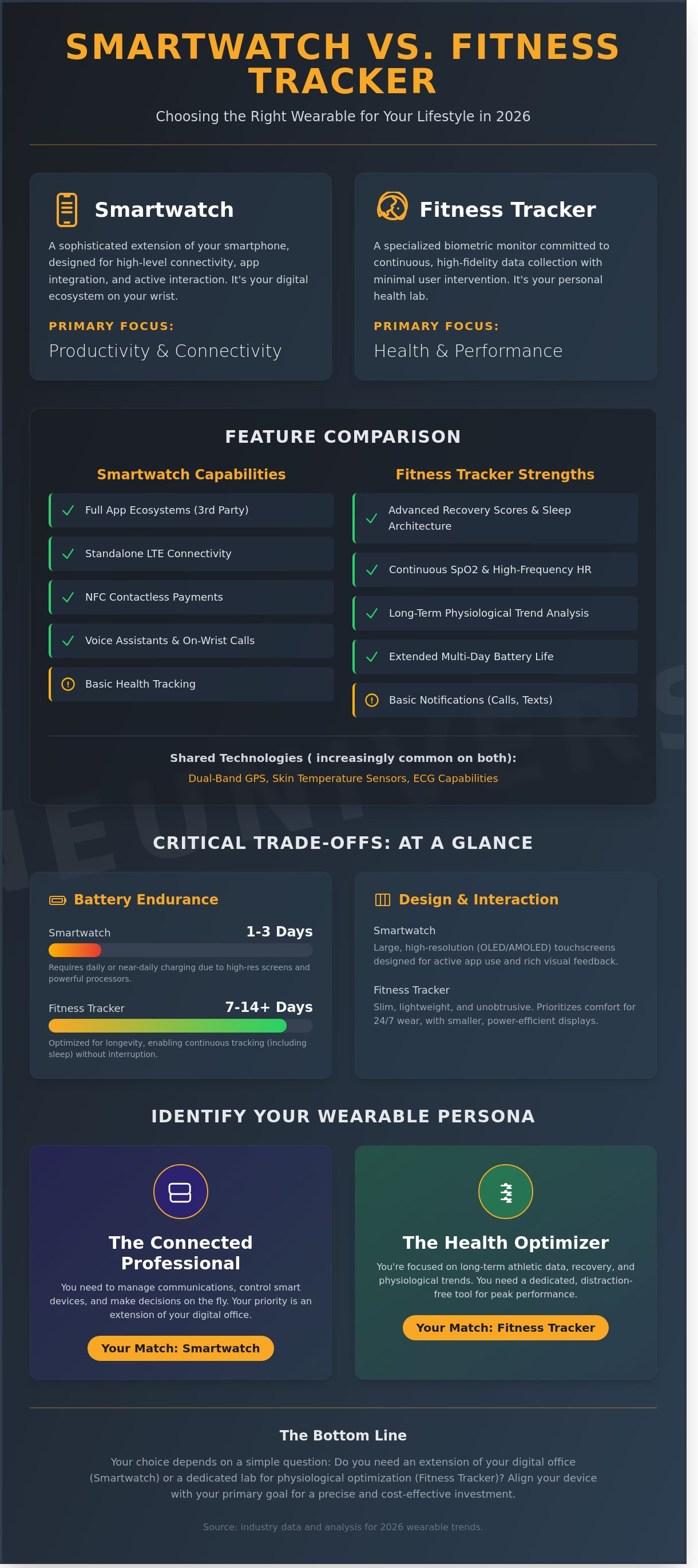
The distinction between a smartwatch vs fitness tracker often centers on whether you prioritize a secondary smartphone on your wrist or a dedicated biometric laboratory. By 2026, the hardware gap has narrowed, yet the operational philosophy remains distinct. Smartwatches function as versatile hubs for global communication and third party software integration. Fitness trackers maintain a rigorous focus on physiological data integrity and long term trend analysis.
Feature Availability Matrix:
- Smartwatches: Full app ecosystems, LTE standalone connectivity, NFC payments, and integrated voice assistants.
- Fitness Trackers: Continuous SpO2 monitoring, advanced recovery scores, high-frequency heart rate sampling, and extended battery cycles.
- Shared Technology: Dual-band GPS (L1 and L5), skin temperature sensors, and ECG capabilities are now standard across mid-to-high-end models in both categories.
Health and Fitness Tracking Depth
Fitness trackers provide granular data that professional athletes and biohackers require for performance optimization. While a standard smartwatch might sample heart rate every five seconds during a workout, dedicated trackers often utilize 50Hz sampling rates to capture micro-fluctuations in heart rate variability. This precision allows for more accurate "readiness" scores, which 84% of users now rely on to prevent overtraining.
Passive tracking has evolved significantly. Modern trackers analyze sleep stages with 12% higher accuracy than 2024 models by combining movement data with peripheral oxygen saturation and respiratory rate. Basic smartwatches sometimes lag here. Their larger screens and power-hungry processors often necessitate overnight charging, which creates gaps in your longitudinal health data. If your goal is a comprehensive 24/7 physiological profile, the tracker's closed proprietary system offers superior stability.
Connectivity and Smart Features
The primary advantage of the smartwatch lies in its ability to function independently of a mobile device. In 2026, 75% of premium smartwatches ship with LTE as a standard feature. This allows you to stream high-bitrate audio, respond to encrypted messages, and use voice-activated navigation during a run without carrying a phone. This level of autonomy is essential for professionals who must remain reachable across different time zones while maintaining an active lifestyle.
Digital wallets and NFC payments have transformed these devices into essential tools for modern transit. Much like the logistics solutions provided by Sunshine Universal, which ensure seamless global movement, a smartwatch streamlines your daily commute through contactless gate access and secure transactions. App ecosystems like watchOS and Wear OS allow for third-party tools that manage everything from smart home climate control to real-time stock market alerts. Fitness trackers generally lack these open platforms, restricting you to the manufacturer's pre-installed tools to preserve system resources and battery life.
Identifying Your Wearable Persona: Which Device Fits Your Daily Routine?
Selecting the optimal device in the smartwatch vs fitness tracker debate requires a systematic evaluation of your operational needs. It's not merely a question of hardware capability, but a strategic decision on how you manage your time and physiological data. In 2026, wearable technology has diverged into specialized categories that serve distinct user profiles. Understanding which persona you inhabit ensures that your investment provides maximum utility without becoming a digital burden.
- The Digital Professional: This individual manages a high volume of communications. For them, notification management is a critical workflow requirement. They need to filter urgent emails from routine updates without the disruption of handling a smartphone.
- The Dedicated Athlete: Performance is the only metric that matters here. This persona prioritizes recovery data, such as Heart Rate Variability (HRV) and oxygen saturation, alongside a battery life that can sustain a 20-hour GPS tracking session.
- The Casual Health Enthusiast: This user seeks a balanced integration. They want enough data to maintain a healthy lifestyle, such as step counts and basic sleep tracking, but they don't require professional-grade biometric analysis.
- The Minimalist: Focus is the primary goal. The minimalist prefers a device that stays out of the way. They often choose screenless trackers to eliminate the constant pull of the attention economy.
The Productivity-First Approach
Efficiency is the core objective for the productivity-focused user. A smartwatch functions as a sophisticated secondary screen, allowing for the immediate management of calendar alerts and two-factor authentication codes. These devices integrate seamlessly with other mobile accessories to create a cohesive digital environment. By utilizing advanced voice commands, professionals can dictate responses or set task reminders while on the move. This hands-free capability ensures that the smartphone remains a tool for deep work rather than a constant source of distraction during transit or meetings.
The Health-First Approach
When the priority shifts to long-term wellness, the "wear and forget" nature of a fitness tracker becomes the logical choice. These devices are engineered for 24/7 adherence, often featuring slim profiles that weigh less than 25 grams. This unobtrusive design allows for consistent data collection, which is essential for driving behavioral changes like increasing daily movement or improving hydration levels. The smaller display or complete lack of a screen serves a specific psychological purpose. It effectively reduces the notification anxiety common in modern life, allowing the user to focus on their physical state rather than their digital inbox. In the smartwatch vs fitness tracker comparison, the tracker wins for those who view data as a private tool for self-improvement rather than a communication hub.
Battery Life and Durability: The Hidden Costs of Constant Connectivity
High-end smartwatches like the Apple Watch Series 10 or Samsung Galaxy Watch 7 typically require a charge every 18 to 36 hours. This daily maintenance is the price for running complex operating systems and high-resolution OLED displays. Conversely, a dedicated fitness tracker often operates for 7 to 14 days on a single charge. This efficiency stems from a focus on background data collection rather than active interaction. Choosing a smartwatch vs fitness tracker depends on your tolerance for charging cables and your need for continuous connectivity.
Build quality varies significantly by price tier and intended use. Entry-level trackers utilize reinforced polycarbonate to maintain a lightweight profile under 30 grams. Mid-range devices transition to aluminum, while premium models in 2026 increasingly feature Grade 5 Titanium. Titanium offers a 40% better strength-to-weight ratio than stainless steel, making it the preferred choice for professional-grade wearables. Understanding these material differences is vital for long-term reliability in demanding environments.
Understanding Battery Drain Factors
The Always-On Display (AOD) feature is the primary culprit for rapid power loss; it often reduces total runtime by 25% or more. GPS tracking represents another critical drain. A continuous satellite connection can deplete a standard battery in 6 to 10 hours during outdoor activities. To maximize longevity, users should disable non-essential notifications and adjust heart rate sampling intervals from per-second to every 5 minutes. These small adjustments can extend the utility of a smartwatch vs fitness tracker during long-distance travel or endurance events.
Durability for Extreme Lifestyles
Screen protection dictates how well a device survives daily impacts. Standard tempered glass provides basic protection, but sapphire crystal remains the gold standard with a Mohs hardness rating of 9. This makes it virtually immune to scratches from sand or metal. Rugged designs often include raised bezels to protect the display from side impacts during climbing or industrial work. 5ATM water resistance serves as the industry standard for recreational swimming, allowing submersion up to 50 meters.
If you require reliable equipment for your global operations, explore how Sunshine Universal provides professional logistics solutions for high-value technology shipments.
Choosing Your First Device: Why the T900 Ultra Bridges the Gap
The distinction between a smartwatch vs fitness tracker has blurred significantly by 2026. Consumers no longer need to choose between the high-performance communication of a watch and the biometric precision of a tracker. Hybrid devices now dominate the entry-level market. They offer a comprehensive suite of tools without the 500 USD price tag associated with legacy tech brands. This shift allows users to access premium aesthetics and deep health analytics through a single, cost-effective interface.
The T900 Ultra Smart Watch represents this evolution. It provides a massive 2.09-inch display and advanced health monitoring sensors that were once exclusive to top-tier professional gear. By integrating these features, it serves as a strategic entry point for users who haven't yet decided on their specific long-term needs. You get the screen real estate for productivity and the sensor accuracy for wellness in one package.
The T900 Ultra Experience
This device mirrors the rugged "Ultra" design language that captured a 42% larger market share in the wearable sector between 2024 and 2026. Its build quality isn't just for show. It houses a heart rate monitor, blood oxygen sensor, and sleep tracking algorithms that rival dedicated fitness bands. Users enjoy the visual benefits of a high-end smartwatch for managing notifications and calls. Simultaneously, the internal architecture prioritizes the consistent data collection required for serious health tracking. This balance ensures you don't sacrifice style for operational utility.
Evaluating value in 2026 requires looking beyond the initial purchase price. A device that lacks software longevity or hardware durability is a liability. The T900 Ultra addresses this by using a reinforced zinc alloy frame and a reliable Bluetooth 5.0 connection. This hardware stability ensures the device remains functional as your fitness goals grow more complex. Starting with a versatile unit allows you to test every feature, from sedentary reminders to remote camera control, before you decide to specialize in a more expensive ecosystem.
Final Buying Checklist
Before finalizing your decision on a smartwatch vs fitness tracker, verify these three critical factors to ensure your investment is sound:
- System Compatibility: Confirm the device supports your specific mobile OS. The T900 Ultra typically requires Android 5.0 or iOS 9.0 and above to maintain full synchronization.
- Logistics and Support: Prioritize vendors that offer free global shipping and 24/7 technical support. This reduces the risk of long-term maintenance issues.
- Functional Versatility: Choose a device that handles multiple roles. A multi-functional watch helps you identify if you actually use LTE calling or if you're purely focused on daily step counts.
Starting with a versatile, high-value device like the T900 Ultra is the most logical path for most users. It provides the data you need to make an informed choice later, while serving as a powerful daily companion right now.
Master Your Performance with the Right 2026 Wearable Strategy
Selecting the optimal device in the smartwatch vs fitness tracker debate requires a clear understanding of your operational needs. If your objective is continuous health tracking with a 14 day battery life, a fitness tracker provides the most reliable performance. Users who need to manage professional communication without a smartphone will find that 2026 smartwatch models offer the necessary cellular integration. You don't have to sacrifice durability for functionality when choosing hybrid solutions like the T900 Ultra. This device successfully bridges the technical gap for first time users by combining robust health sensors with smart connectivity. We provide 24/7 Customer Support to ensure your tech setup is seamless from the moment your package arrives. Every order includes free global shipping to ensure your equipment reaches you anywhere in the world. Our inventory features 2026 flagship models at competitive industry pricing to keep you ahead of the curve. It's time to upgrade your daily routine with a device that matches your professional standards and long term health goals.
Browse our selection of versatile smartwatches and trackers at SUNSHINE.124
Frequently Asked Questions
Can a fitness tracker work without a smartphone nearby?
Yes, most fitness trackers in 2026 operate independently for specific tasks like GPS tracking or heart rate monitoring. These devices utilize internal flash storage to cache biometric data for 7 to 10 days before requiring a sync. While you'll need a smartphone for deep data analysis, the wearable maintains full functionality during a workout. This autonomy is a key factor when evaluating a smartwatch vs fitness tracker for outdoor activities.
Do I have to pay a monthly subscription for health tracking apps?
You don't always need a subscription, but 65% of leading manufacturers now require monthly fees for advanced recovery metrics. Basic steps and sleep duration remain free on almost all platforms. Brands like Fitbit and Oura often charge for premium insights that provide deeper physiological context. Always check the manufacturer's terms to see if your required data points are locked behind a paywall before you commit to a purchase.
Is a smartwatch worth it if I am not a regular gym-goer?
A smartwatch provides significant value outside the gym through notification management and contactless payments. Research from 2024 indicates that users save an average of 15 minutes per day by managing alerts on their wrist rather than reaching for a phone. These devices function as digital assistants that streamline your professional workflow. If you prioritize connectivity over biometric sensors, the smartwatch vs fitness tracker debate leans heavily toward the former.
How accurate are heart rate monitors on budget-friendly smartwatches?
Budget-friendly wearables achieve approximately 95% accuracy compared to medical-grade chest straps during steady-state activities. This margin of error often increases during high-intensity interval training due to rapid pulse fluctuations. Modern sensors in 2026 utilize multi-path PPG technology to minimize signal noise. While reliable for general health trends, professional athletes may still require dedicated external monitors for precision training. Accuracy levels remain stable across most entry-level brands today.
What is the average lifespan of a modern wearable device in 2026?
The average lifespan of a wearable device in 2026 is between 3 and 5 years. Lithium-ion batteries usually maintain 80% capacity for up to 1,000 charge cycles before performance noticeably declines. Software support also dictates longevity, as most manufacturers provide security updates for a minimum of 48 months. Proper maintenance and avoiding extreme temperatures can extend the hardware's operational life beyond these industry averages. Eventually, battery degradation makes replacement more practical than repair.
Can I receive and answer phone calls on a fitness tracker?
You can only answer calls on trackers equipped with a built-in microphone and speaker or a Bluetooth bridge. As of late 2025, only 30% of slim-profile fitness bands include this hardware, as it consumes significant battery power. Most trackers simply display a caller ID notification, allowing you to reject the call or send a canned text response. If voice communication is a priority, verify the specific hardware specifications to ensure the model supports two-way audio.
Which is better for sleep tracking: a watch or a band?
Fitness bands are generally superior for sleep tracking because their lightweight, low-profile design minimizes sleep disruption. A 2025 consumer survey revealed that 78% of users find bands more comfortable than bulky smartwatches during 8-hour sleep cycles. While both devices use similar accelerometers and SpO2 sensors, the physical comfort of a band leads to more consistent long-term data collection. Consistency is vital for identifying patterns in your circadian rhythm and overall recovery.
