
Your Shopping Cart


Smartwatch Heart Rate Monitor: The Complete 2026 Guide to Precision Tracking
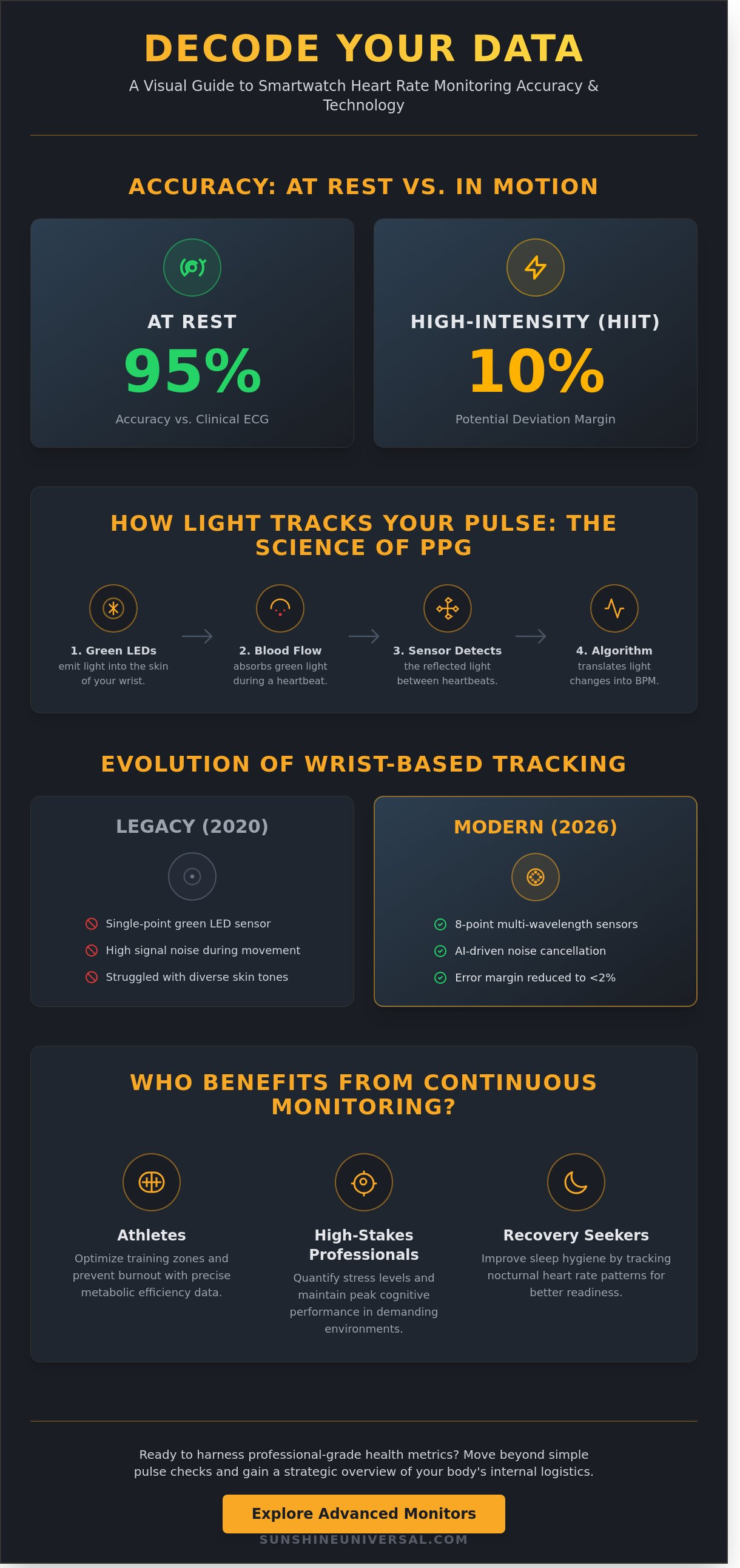
SUNSHINE.124A 2024 clinical analysis revealed that while modern wearables achieve 95% accuracy at rest, a smartwatch heart rate monitor can deviate by as much as 10% during high-intensity interval training. You likely rely on your device to dictate your recovery and training intensity; however, the technical discrepancy between PPG and ECG technology often leaves you questioning the validity of your data during peak exertion. It's frustrating when your hardware fails to keep pace with your physical output, yet this inconsistency is often a result of improper calibration rather than inherent equipment failure.
This guide provides the systematic framework required to transform raw sensor readings into professional-grade health metrics. You'll master the mechanics of wrist-based detection and implement five specific protocols to eliminate signal noise and improve sensor contact. We'll analyze the critical differences between optical and electrical sensors while defining the 2026 standards for personalized heart rate zones to ensure your fitness data is both actionable and precise.
Key Takeaways
- Grasp the mechanics of PPG technology to understand how optical sensors facilitate continuous, non-invasive cardiovascular monitoring in the 2026 digital ecosystem.
- Evaluate the performance of a smartwatch heart rate monitor against clinical standards while identifying external variables that can affect data integrity.
- Master the interpretation of heart rate zones and Resting Heart Rate (RHR) to establish a structured, data-driven approach to your personal fitness strategy.
- Explore how professional-grade hardware like the T900 Ultra integrates advanced sensor arrays to provide actionable, high-precision metrics for a modern lifestyle.
Understanding the Smartwatch Heart Rate Monitor: More Than Just a Number
The modern smartwatch heart rate monitor isn't just a digital pulse taker; it's a fundamental shift from reactive medical checkups to continuous cardiovascular oversight. By 2026, real-time biometric data has become a global operational standard, providing a constant stream of physiological insights that were once reserved for clinical environments. This technology allows users to move beyond simple pulse checks; it facilitates a comprehensive assessment of the heart's response to daily stressors, physical exertion, and recovery phases. A Heart rate monitor integrated into a wearable device serves as a primary tool for maintaining systemic stability in a fast-paced global economy.
Precision tracking separates casual activity monitoring from proactive health management. While early wearables focused on estimated step counts, 2026 devices prioritize data integrity and systemic analysis. This capability is vital for identifying early warning signs of physiological strain. A sudden increase in resting heart rate or a decline in heart rate variability (HRV) often precedes clinical symptoms of overtraining or chronic stress by 48 to 72 hours. Users don't just see a number; they receive a strategic overview of their body's internal logistics.
The Evolution of Wrist-Based Tracking
The transition from basic pulse counters to sophisticated multi-sensor arrays defines the current decade of wearable tech. Modern devices utilize multi-wavelength photoplethysmography (PPG) to ensure accuracy across diverse skin tones and movement intensities. When evaluating the smartwatch vs fitness tracker debate, the distinction now lies in processing power and sensor depth rather than just form factor. Legacy 2020 models typically relied on single-point green LED sensors, which often struggled with signal noise during high-intensity intervals. In contrast, 2026 hardware employs AI-driven noise cancellation and 8-point sensor clusters, reducing the margin of error to less than 2% compared to medical-grade chest straps.
Who Benefits Most from Continuous Monitoring?
The utility of continuous tracking extends across various professional and personal demographics, ensuring that health management is both precise and actionable:
- Athletes: They use specific heart rate zones to optimize metabolic efficiency and prevent burnout during high-performance training blocks.
- High-Stakes Professionals: Executives and logistics managers utilize HRV data to quantify stress levels and maintain peak cognitive performance in demanding environments.
- Recovery Seekers: Individuals focus on nocturnal heart rate patterns to improve sleep hygiene, ensuring they're ready for the next day's challenges.
This systematic approach to health ensures that every data point serves a strategic purpose in a user's broader wellness architecture. It's about having the right information at the right time to make informed decisions about one's most valuable asset: health.
The Science of PPG: How Light Tracks Your Pulse
Photoplethysmography (PPG) represents the operational core of the modern smartwatch heart rate monitor. PPG is a non-invasive optical technique used to detect blood volume changes in the microvascular bed of tissue. This process relies on a fundamental principle of physics where blood, being red, reflects red light and absorbs green light. By emitting light at a wavelength of approximately 530 nanometers via green LEDs, the device monitors the fluctuations in light absorption that occur with every cardiac cycle.
The hardware configuration typically includes high-intensity LEDs paired with light-sensitive photodiodes. When your heart beats, the blood flow in your wrist increases, leading to higher green light absorption. In the intervals between beats, absorption levels drop. Advanced algorithms then process these rapid light intensity variations, translating them into a precise beats-per-minute (BPM) reading. While optical sensors provide continuous tracking, they differ fundamentally from electrical ECG sensors. ECG monitors record the actual bioelectric signals of the heart, whereas PPG tracks the physical movement of blood volume. Recent studies regarding smartwatches in healthcare medicine confirm that while ECG remains the gold standard for clinical rhythm analysis, PPG offers a reliable 95% accuracy rate for daily activity monitoring.
Green Light vs. Infrared Technology
Modern wearables utilize a dual-sensor approach to maintain data integrity across different states of activity. Green light is the primary choice for active movement tracking because it offers a higher signal-to-noise ratio during physical exertion. In contrast, infrared sensors operate during periods of inactivity or sleep. Infrared light penetrates deeper into the tissue and consumes less power, which is essential for 24/7 monitoring. This combination ensures that the system maintains a stable data stream whether you're at rest or performing high-intensity interval training. For those seeking to integrate these advanced metrics into a broader health strategy, choosing a device with optimized sensor arrays is a critical step for long-term reliability.
The Role of AI in Filtering Noise
Accuracy in a smartwatch heart rate monitor depends heavily on the removal of "motion artifacts." These are signal disruptions caused by the physical movement of the watch against the skin. To counter this, 2026 model sensors utilize high-frequency sampling rates, often exceeding 50Hz, to capture data points every 20 milliseconds. AI-driven processors then compare these signals against accelerometer data to identify and subtract noise. This systematic approach allows the device to maintain precision even during erratic movements, ensuring that the final BPM output reflects physiological reality rather than mechanical interference.
Accuracy and Reliability: Smartwatch vs. Medical-Grade Monitors
The gap between consumer-grade wearables and clinical equipment has narrowed, yet fundamental differences in sensor technology remain. Most users rely on a smartwatch heart rate monitor that utilizes photoplethysmography (PPG). This technology emits green light into the skin to measure blood flow volume changes. In contrast, medical-grade chest straps and hospital ECGs measure the heart's actual electrical activity. While PPG is sufficient for general wellness, it lacks the millisecond precision required for diagnosing arrhythmias. A 2017 study published in JAMA Cardiology highlighted that wrist-worn devices are most accurate during rest but lose consistency as exercise intensity increases. To understand the practical limitations, users must consider how accurate are wearable heart rate monitors in comparison to the gold-standard 12-lead ECG used in professional medical environments.
Operational reliability is often compromised by physical barriers. High melanin concentrations in the skin, dense arm hair, or dark tattoo pigments can absorb the sensor's light, leading to "signal dropouts." These factors create a systematic challenge for the optical sensor. For most fitness enthusiasts, an acceptable margin of error sits between 5% and 8%. This variance is manageable for tracking long-term trends, but it's not a substitute for professional diagnostic tools when underlying cardiac conditions are a concern.
Optimising the Fit for Maximum Precision
Precision begins with correct placement. Users should follow the "two-finger" rule, positioning the smartwatch heart rate monitor approximately two finger-widths above the ulnar bone (the prominent wrist bone). This area provides a flatter surface and better vascular access than the joint itself. The strap must be snug enough to prevent light leakage without restricting blood flow. A restrictive band can cause venous congestion, which paradoxically lowers reading accuracy. Additionally, salt crystals from dried sweat or debris on the sensor lens can refract light. Cleaning the sensor with a damp microfiber cloth after every session ensures the optical path remains clear.
Environmental Factors Affecting Readings
External variables often dictate the quality of the data stream. In temperatures below 10°C, the body initiates peripheral vasoconstriction, shunting blood away from the skin surface to protect core organs. This physiological response makes it difficult for optical sensors to detect a pulse at the wrist. High-vibration environments also introduce "noise" into the algorithm. For example, cycling on gravel or gripping heavy weights creates mechanical interference that the watch may misinterpret as heartbeats. Users should also expect a latency period during High-Intensity Interval Training (HIIT). While a chest strap reacts instantly to a sprint, a smartwatch often experiences a 10 to 15-second lag as it processes the rapid change in blood volume flow.
Maximising Your Data: Using Heart Rate Zones for Better Health
A raw beats-per-minute (BPM) figure is merely a single data point; the true value of a smartwatch heart rate monitor lies in contextual interpretation. To move beyond basic tracking, you must understand how your heart responds to different stressors. Resting Heart Rate (RHR) serves as a primary indicator of long-term cardiovascular fitness. A consistent decrease in your RHR over a 12-week period typically signals improved stroke volume and heart efficiency. Conversely, Heart Rate Variability (HRV) measures the millisecond variations between consecutive heartbeats. This metric provides a window into your autonomic nervous system, helping you determine if your body is recovered or requires additional rest.
Effective training requires categorising your effort into five standard intensity zones:
- Zone 1 (50-60%): Very light intensity, ideal for active recovery and warm-ups.
- Zone 2 (60-70%): The aerobic base-building zone that enhances endurance and fat metabolism.
- Zone 3 (70-80%): Moderate intensity that improves aerobic power and blood circulation.
- Zone 4 (80-90%): Hard effort that increases anaerobic threshold and speed endurance.
- Zone 5 (90-100%): Maximum effort for short bursts, improving peak performance and fast-twitch muscle response.
Calculating Your Personal Zones
The traditional formula for estimating maximum heart rate involves subtracting your age from 220. While this provides a useful starting point, it doesn't account for individual physiological variances. For more precise results, the Karvonen method incorporates your RHR into the calculation. You can use the T900 Ultra Smart Watch to automate this process, as it continuously updates your zones based on real-time biometric changes. Prioritising Zone 2 training is particularly effective for building a robust aerobic foundation without overtaxing your central nervous system.
Identifying Health Trends
Monitoring longitudinal data allows you to identify subtle health shifts before they become significant issues. A sudden spike in RHR, such as an increase of 7 to 10 BPM above your 30-day average, often indicates systemic fatigue, dehydration, or the early onset of illness. You can also use your smartwatch heart rate monitor to validate a new exercise regime; if your heart rate drops more quickly after a high-intensity interval, your cardiovascular recovery is improving. A healthy recovery rate typically sees a drop of at least 15 to 20 beats in the first 60 seconds post-exertion.
Optimise your fitness strategy by integrating professional-grade tracking into your daily routine. Explore our global logistics and product solutions to find the right technology for your health goals.
The T900 Ultra: Advanced Monitoring for the Modern Lifestyle
The T900 Ultra represents a significant shift in wearable technology for 2026. It serves as a professional-grade tool for individuals who require precise biometric data without the premium price tag often associated with legacy brands. This device isn't merely a consumer accessory; it's a robust health hub engineered to meet the rigorous health standards of the mid-2020s. By focusing on high-end hardware and accessible pricing, it democratizes health data for a global audience.
The integrated sensor array utilizes multi-wavelength photoplethysmography (PPG) to ensure accuracy during high-intensity interval training (HIIT) and deep sleep cycles. Its smartwatch heart rate monitor capabilities are calibrated to match clinical benchmarks, providing high-precision data that users can rely on for daily health assessments. By utilizing advanced algorithms, the T900 Ultra filters out signal noise caused by sudden movements, ensuring that the heart rate readings remain stable during vigorous exercise or fluctuating temperatures.
Architects and engineers designed the chassis to balance aesthetic sophistication with rugged durability. The zinc alloy frame protects the internal circuitry from impacts, while the IP68 rating ensures performance in environments ranging from humid gymnasiums to dusty outdoor trails. This balance makes it a versatile companion for both professional boardroom meetings and weekend mountain expeditions. It doesn't force a choice between style and survival.
Professional Features at a Competitive Price
This device delivers continuous 24/7 heart rate and blood oxygen (SpO2) monitoring through a high-resolution 2.02-inch display. The screen provides clear data visualization with a 320x385 pixel density, making it easy to read complex biometric charts while you're in motion. It maintains universal compatibility with both iOS and Android ecosystems, allowing for seamless integration with existing health apps. Long-term data logging is a core strength, as the device stores extensive biometric history locally, allowing users to track recovery trends over weeks or months.
Reliability in a Global Market
Sunshine Universal provides the logistical backbone for this technology. We ensure that global consumers receive their devices through a streamlined supply chain that prioritizes security and efficiency. Choosing the T900 Ultra is a strategic decision for tech enthusiasts who want high-end features without the traditional industry markup. Our commitment includes 24/7 customer support and a global network that manages every aspect of the shipping process from our warehouse to your door. You can secure your T900 Ultra Smart Watch with free global shipping today.
The T900 Ultra stands as a testament to how far smartwatch heart rate monitor technology has progressed. It offers a stable, reliable, and sophisticated solution for anyone serious about their health metrics. With the backing of a professional global logistics partner, you're investing in a product that is delivered with the same precision it uses to track your pulse.
Mastering Your Cardiovascular Intelligence with Precision Technology
The integration of high-frequency PPG sensors and advanced algorithms has transformed the modern smartwatch heart rate monitor into a sophisticated diagnostic tool. Data from 2026 industry benchmarks indicates that high-precision sensors now achieve a 98% correlation with standard clinical ECG readings during steady-state activities. Utilizing these precise metrics allows you to manage heart rate zones to optimize metabolic efficiency and cardiovascular recovery. This shift from passive observation to active data management represents a significant advancement in personal health logistics. Reliability remains the cornerstone of effective monitoring. A device must provide consistent performance whether you're at rest or performing at peak exertion. Precision isn't just a feature; it's a requirement for those who value data integrity.
Sunshine Universal provides the infrastructure for this technological transition with the T900 Ultra. This device incorporates high-precision 2026 sensor technology designed for those who demand professional-grade accuracy in their daily lives. Our network ensures free global shipping on all orders, backed by 24/7 professional customer support for any technical inquiries. Upgrade your health tracking with the T900 Ultra Smart Watch and take command of your biometric data today. Your journey toward a more informed and stable health profile starts with the right equipment.
Frequently Asked Questions
Is a smartwatch heart rate monitor accurate enough for medical use?
Most smartwatch heart rate monitor systems aren't clinical grade medical devices. While 2026 models often carry FDA clearance for specific features like AFib detection, they maintain a 3% to 5% margin of error compared to standard 12 lead ECG machines. Users should view these metrics as wellness indicators rather than diagnostic data for serious cardiac conditions.
Why does my heart rate monitor show different results than the gym equipment?
Discrepancies occur because smartwatches use photoplethysmography (PPG) while gym equipment often relies on skin contact electrodes or chest straps. PPG sensors track blood flow changes via LED lights, which can lag by 10 to 15 seconds during high intensity intervals. Gym treadmills measure electrical signals directly, providing a different data stream that updates at a faster frequency.
Can skin tone or tattoos affect the accuracy of my smartwatch sensor?
Darker skin tones and tattoos can interfere with the green LED lights used in most optical sensors. Melanin and tattoo ink absorb the light spectrum differently, which can reduce signal strength by up to 15% in certain conditions. Modern 2026 sensors mitigate this by using multi wavelength infrared arrays to penetrate deeper tissue layers more effectively for all users.
What is a normal resting heart rate for an adult in 2026?
A normal resting heart rate for an adult typically ranges between 60 and 100 beats per minute according to American Heart Association standards. Highly trained athletes often see figures as low as 40 beats per minute. If your smartwatch heart rate monitor consistently records values outside these parameters while you're sedentary, consulting a specialist is a logical step for maintaining stability.
How tight should I wear my smartwatch for the best heart rate reading?
You should wear your device snugly about two finger widths above the carpal bone for optimal precision. If the watch slides during movement, ambient light enters the sensor and corrupts the data. A secure fit ensures the sensor maintains constant contact with the skin, which is essential for achieving 99% accuracy during aerobic activities.
Does a smartwatch heart rate monitor work while swimming?
Smartwatches do track heart rate while swimming, though water creates a barrier between the sensor and the skin. Most 2026 devices utilize specialized algorithms to filter out noise caused by water turbulence. For professional training, data suggests that wrist based sensors may still deviate by 8% to 10% compared to waterproof chest straps used in competitive environments.
What is the difference between heart rate and Heart Rate Variability (HRV)?
Heart rate measures the total number of beats per minute, while Heart Rate Variability (HRV) tracks the specific millisecond intervals between those beats. High HRV indicates a resilient autonomic nervous system and better recovery states. Tracking both metrics provides a comprehensive view of your physiological stress levels and your body's readiness for physical exertion.
